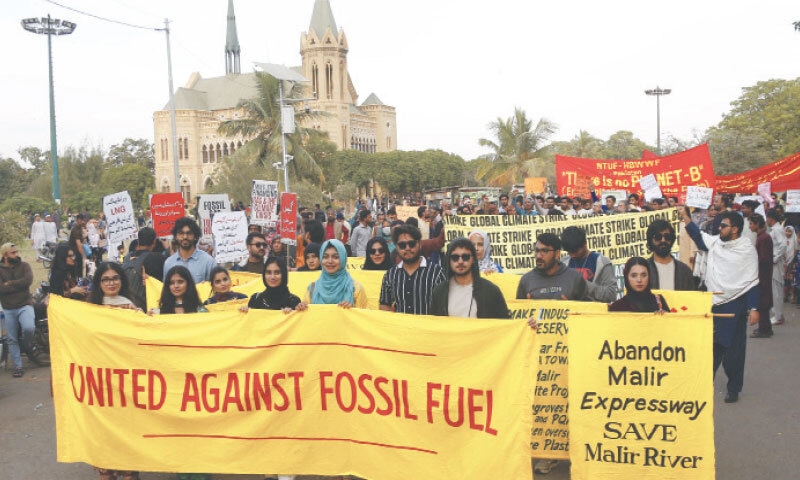
KARACHI: Activists and people from all walks of life participated in the Climate March 2025 to express their concern over the effects of climate change in the city, country and the rest of the world.
The march, which was organised by the members of civil society, was started from Frere Hall. The participants proceeded towards the Karachi Press Club. A large number of people, including rights activists, trade union members, students, women and children, participated in the walk.
They expressed concerns over climate change by chanting slogans and waving placards and holding banners.
One of the banners in the red colour background read: “There is no Planet B”. Another big one called for an end to coal use, urging protection for people from unhealthy wastewater and air pollution, while another carried the message “Right to Life”.
Some participants lay down on the road while displaying placards to register their protest. One such placard read: “The reason behind climate change is capitalism and feudalism.”
Participants say working class is the worst affected by climate crisis; activist Yasir Darya claims less than 50 electric buses operating in Karachi
Several protesters were also seen wearing Palestinian keffiyeh scarves and carrying Palestinian flags to express solidarity with the people of Palestine.
Attending the march, labour union leader Nasir Mansoor told Dawn that the working class is the worst affected by climate change, as they are displaced or even lose their lives due to heatwaves or excessive rainfall.
He added that during past heatwaves, 70 per cent of those who died were members of the working class.
Speaking about the issues, he said that a transition from fossil fuels to clean and renewable energy in industries and other sectors was necessary, but it should not lead to lay-offs of workers. He further demanded that the government, in implementing such a transition, must work in consultation with working-class organisations to ensure protection of workers’ rights.
“Without the end of capitalism, the question of climate change remains incomplete,” Mr Mansoor claimed.
Home-Based Women Workers Federation Secretary General Zehra Khan said that heat stress is increasing, particularly among labourers working in garment factories, where workers often faint due to extreme heat, making it essential for factories to have proper cooling systems.
She added that while the Sindh Occupational Safety and Health Act exists, it does not mention heat stress leave.
She said the legislature should provide legal safeguards on the issue so that workers can be entitled to heat stress leave.
Speaking to Dawn, environmental activist Yasir Darya said that industries and sectors using fossil fuels should be transitioned at the earliest, adding that this transition must include electric vehicles, particularly electric buses in public transport.
He further said that a Chinese electric car manufacturing company was setting up a plant in Sindh, but stressed that more such plants were needed so that locally manufactured buses could be made cheaper and also exported to African countries.
He claimed that the country has a total of 300 to 400 electric buses, and under 50 are operating in Karachi, while the rest are in cities of Punjab.
Criticising the government, he said the situation reflected negligence on the part of the city administration and the Sindh government.