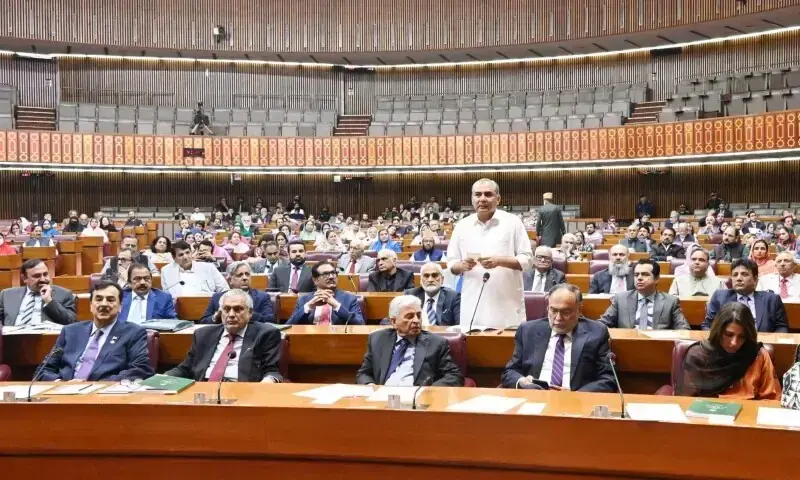
The National Assembly (NA) and Senate on Wednesday endorsed President Asif Ali Zardari’s proclamation of emergency in Khyber-Pakhtunkhwa (K-P), passing resolutions by majority votes despite opposition lawmakers’ objections to the imposition of emergency measures in the province.
The developments emerged after the federal government imposed emergency and governor’s rule in K-P on October 11, suspending the Pakistan Tehreek-e-Insaf (PTI)-led provincial administration amid a dispute over the province’s security situation and counter-terrorism measures. The government has defended the move, citing a deterioration in law and order and an alleged failure by the provincial administration to coordinate counter-terrorism efforts with federal authorities.
The NA session began under the chairmanship of Speaker Ayaz Sadiq as Minister for Parliamentary Affairs Tariq Fazal Chaudhry presented the resolution before the House. During the proceedings, Chaudhry moved a separate motion seeking the suspension of question hour to allow the House to take up other parliamentary business. Opposition lawmakers opposed the motion, but it was adopted by a majority vote.
The Lower House later debated the emergency measures imposed in the province, with opposition lawmakers strongly opposing the Centre’s decision and raising a hue and cry during the proceedings. However, the resolution was passed by a majority vote. The NA session was subsequently adjourned until 11am on Friday.
Following the approval from NA, the Senate session was held under the chairmanship of Chairman Yousaf Raza Gilani. During the proceedings, the Senate also approved a motion moved by Senator Shahadat Awan to defer the question-and-answer session scheduled for the day.
Speaking in the upper house, Law Minister Azam Nazeer Tarar said Rules 132 and 133, which govern ordinary resolutions moved by private members, did not apply to a resolution introduced under a constitutional requirement. He added that the seven-day notice requirement was not applicable in this case.
Rejecting objections to the procedure, the law minister also said the government could not deviate from the Constitution or the rules and regulations of the House.
He maintained that members opposing the resolution should participate in the debate and, if they disagreed with it, reject it through a vote.
The minister called for the matter to be put to a vote after discussion so that the opinion of the House could be ascertained. Following this, the Senate approved the imposition of emergency in K-P as the opposition walked out in protest.
Later in the day, the president summoned a joint session of Majlis-e-Shoora (Parliament) tomorrow morning at 11 under Clause 1, Section 54 (Summoning and prorogation of Majlis-e-Shoora) of the Constitution of Pakistan. The notification regarding it was issued by the NA today.
In a separate notification issued by the NA Legislation Adviser Muhammad Mushtaq, the secretariat demanded the production of NA Members Sana Ullah Khan Masti Khel and Dawar Khan Kundi for all the upcoming NA sessions. The lawmakers are currently in the custody of Punjab Police.
The adviser further outlined that the MNAs will be handed back to the cops after the commencement of NA sessions.
Earlier, while speaking on the NA floor, the law minister had said the K-P government’s approach to combating terrorism had become a “threat to national security”, as the federal government tabled a resolution in the NA seeking parliamentary approval of the emergency imposed in the province under Article 232 of the Constitution.
Speaking during the session, Minister Tarar said the Constitution required a presidential proclamation of emergency under Article 232 to be laid before both houses of parliament — the National Assembly and the Senate — for approval within 10 days of its issuance. Responding to criticism that the imposition of emergency had resulted in the removal of an elected provincial government, Tarar said the decision had been taken after extensive deliberations and a thorough assessment of the security situation in K-P.
He said the federal cabinet had held a two-and-a-half-hour discussion before recommending the emergency measures to the prime minister, citing internal disturbances and cross-border incursions as major factors behind the decision.
“The attitude that the K-P provincial government has maintained regarding the war against terror, particularly over the past one year, since the present cabinet took control there, from Oct 15, 2025, to an alarming degree, was becoming a threat to national security,” he remarked.
The law minister emphasised that effective counter-terrorism operations required close coordination between the federal and provincial governments, stressing that a unified response was essential to ensuring Pakistan’s security.
He said the sharp increase in terrorist activities since 2021 had been driven by several factors, including external, diplomatic and political developments, accusing PTI of pursuing policies that had aggravated the security situation.
Tarar acknowledged the sacrifices made by the armed forces, police personnel and civilians in confronting terrorism, saying their efforts had helped the country make progress despite persistent security challenges. He maintained that political differences should not undermine counter-terrorism efforts, reiterating the importance of cooperation between federal and provincial authorities in addressing threats to national security.
Arguing that the number of terrorist incidents in K-P over the past year was greater than those recorded during the 2021-2024 spell of terrorism, Tarar claimed that non-functional chief minister Sohail Afridi “overlooked the lit fire,” as well as the injuries sustained by the Armed Forces, police, security forces, ulema, and innocent civilians.
“Instead of healing the wounds of the injured, placing his hands over the heads of the widows and orphans of the martyred, attending their funerals, visiting hospitals, reassuring the people, Afridi gave priority to his politics,” the minister said.
He added, “When the situation is extraordinary, when the situation is severe, the actions should also be extraordinary; it should not be routine work.” Tarar said that there were no restrictions on conducting politics, “but when your own public is being martyred, your own youth in the police force and Armed Forces are giving sacrifices, so then you, being the chief executive of the province, is it not the duty of your government that you go and spend time with them, that you conduct daily meetings, morning and evening, bring everyone together, make an action plan, make implementation measures for it?”
The minister said these circumstances were overlooked by Afridi and “it was also declared that there will be an attack on the capital, that it will be conquered.”
He added that instead of “resorting to the use of force to handle this, we emphasised discussions and dialogue,” expressing his gratitude to Speaker Sadiq, who “took a personal interest” in the matter and “in respect of the decision of the president and prime minister, provided a platform for mediation.”
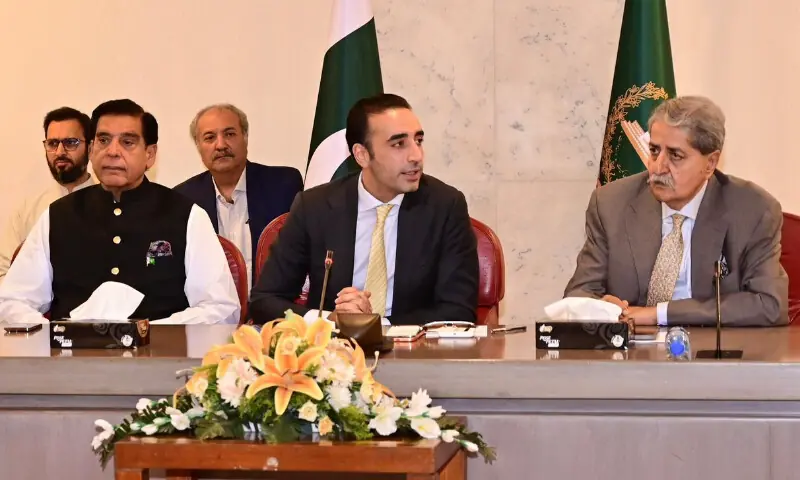
Tarar noted that Interior Minister Mohsin Naqvi, Adviser to the Prime Minister on Political Affairs Rana Sanaullah, Federal Minister for Kashmir Affairs Amir Muqam, along with “our friends and ally” the Pakistan Peoples Party (PPP), “tried their best that matters be handled democratically.”
Tarar added that on directions of the president, PPP Chairman Bilawal Bhutto Zardari designated Naveed Qamar, Sherry Rehman and Aijaz Jakhrani to partake in the discussions. On the opposition side, the minister noted that PTI Chairman Barrister Gohar and Allama Raja Nasir Abbas led the delegation and “sat for two days with their heads together,” Tarar said.
He added that the Constitution and law have set forth a method for proceedings against someone on whom a case was lodged, saying that “if there is anything that can stop this entire process through legal intervention, then that is the court.”
“If you want to free an imprisoned person, in most cases, that is in the control of the court.”
Achakzai calls govt ‘terrorist’, urges reversal of emergency, governor’s rule in K-P
Meanwhile, Pashtunkhwa Milli Awami Party (PkMAP) Chairman Mahmood Khan Achakzai described the government as “a terrorist government”, alleging that it had been formed through money and coercion with the support of uniformed institutions, and defended non-functional chief minister Sohail Afridi’s opposition to what he termed oppression.
Achakzai accused the government of undermining the electoral mandate, alleging that the assemblies had been bought to install a government that did not represent the people’s will. He argued that the PTI had been prevented from contesting the elections under its party symbol and that its candidates had subsequently contested using around 200 different symbols.
“Whether PTI founder Imran Khan was good or bad, whatever he was, I don’t go to the past; you went to such an extent to compete with him that you even snatched the party’s election symbol. You stopped the party from participating in the election,” he said.
Questioning whether the government was punishing the entire country for the PTI’s electoral success, Achakzai asked, “Are you punishing Pakistan’s 240 million people for this?”
He defended Afridi’s stance against the government, saying K-P’s people had shown courage in opposing what he described as terrorism. He maintained that the Afridi had called on people to resist oppression rather than resort to violence. Achakzai also criticised the authorities over Afridi’s treatment, alleging that the Afridi had been arrested and restrained but not brought before the assembly.
“You have done us a great favour, a very great favour! After arresting Afridi and binding his hands and feet, you didn’t bring him here. Do it, do this too. What was he doing, Mr Speaker?” he asked.
Achakzai warned that political confrontation over provincial rights could extend beyond K-P, saying people in Balochistan and Punjab could also resist what he described as the forcible denial of their rights.
He expressed regret over the participation of political representatives from Sindh in the current political situation and warned that the province could face governor’s rule over disputes concerning water and mineral resources.
“Next, governor’s rule will be imposed in Sindh over water, minerals, Canals, and then you will remember what mistake we made,” he said.
Referring to the history of East Pakistan, Achakzai recalled that Mujibur Rehman had worked for the Muslim League before being branded a traitor. He said more than 48% of the people of East Pakistan had voted in favour of Pakistan, invoking the episode to criticise what he described as the denial of political representation.
He also criticised what he called the “Throne of Lahore”, describing it as cruel, and urged the government to reconsider its approach towards the provinces.
Addressing the NA speaker, Achakzai called for the reversal of the government’s decisions and urged lawmakers to restore parliament’s position as the centre of political authority.
“Mr Speaker, there is still time; reverse it, reverse these decisions. Come, make this house a fountainhead of power, ” he said.
Achakzai also questioned the integrity of lawmakers supporting the government, saying some would be unable to uphold their positions if asked to swear on the Quran.
He said the government should reconsider its decisions and allow the assembly to serve as a forum for resolving political disputes rather than deepening confrontation between the centre and the provinces.
3,900 martyred in 14 months amid worsening K-P security situation, says Khawaja Asif
Speaking on the floor of the NA, Defence Minister Khawaja Asif said 3,900 people had been martyred in K-P over 14 months, in addition to 2,700 over three years, as he criticised the provincial government for prioritising political interests over counterterrorism efforts.
Asif called for a united national response to terrorism, saying the province was bearing the greatest burden of violence and could not effectively confront the threat without political cohesion.
He alleged that the non-functional K-P chief minister was more concerned about retaining power than addressing terrorism.
Asif said the Afridi had remained in office for 13 to 14 months and questioned whom he had taken instructions from, alleging that the individual directing him was now in Afghanistan. Asif also criticised the province’s governance, comparing its development over the past 13 years with that of other provinces.
Referring to a Taliban statement condemning an emergency and the deployment of security forces in certain areas, the minister urged the opposition to clarify its political alignments.
“The opponent is the Pakistan state, and the ally is the Taliban whose hands are stained with the blood of our children,” he highlighted during his speech in the lower house.
Alluding to a relative of former premier Imran Khan, whom he said was living in the United States, Asif questioned the extent of that individual’s influence over the province’s affairs, including health-related matters.
“The PTI chairman is a fair-minded person,” Asif said, adding that he could personally vouch for him, while questioning whether the party discussed governance shortcomings internally.
He accused PTI of double standards in its dealings with the military establishment, recalling the party’s past ties with former army chief General Qamar Javed Bajwa and former Inter-Services Intelligence (ISI) chief General Faiz Hameed. He then urged the opposition to examine its own political history before demanding equal treatment, arguing that the government had not made the release of its leaders, including former prime minister Nawaz Sharif, Prime Minister Shehbaz Sharif and Punjab Chief Minister Maryam Nawaz, a political issue when they were imprisoned.
“Until this contradiction stays in our brotherhood, the situation of this country will not be good,” he said, calling for political unity amid the security challenges facing the country.
Recalling the PTI government’s tenure, Asif said opposition members had previously sat alongside military officials during meetings in parliament and supported proposals to bring back individuals he described as terrorists, arguing at the time that their return would benefit Pakistan. He also reminisced about what he described as Imran’s repeated praise for General (R) Bajwa and the military-led government, saying he had heard the PTI founder compliment the former army chief extensively in parliament, the media and meetings.
Turning to his own imprisonment, the defence minister recounted the conditions he faced in jail, saying he had been given only one blanket during a period when temperatures were between seven and eight degrees Celsius. He said PM Shehbaz had arranged for an additional blanket to be smuggled into the prison for him, adding that the person who delivered it had been instructed to ensure it was hidden the following morning.
Asif said he had eaten prison food, describing it as adequate, and that a geyser installed in his cell had subsequently been ordered to be removed.
He also recalled Punjab CM Maryam repeatedly soaking a dupatta in water and placing it over her head to cope with the heat in the cells where she and Nawaz were held at Adiala Jail.
“We didn’t cry. I think it is a matter of pride that we, for our belief, for our ideology, for our doctrine, we suffered these pains.”
The minister further recalled his imprisonment under former military ruler General (R) Pervez Musharraf, saying he had been kept in a six-by-four-foot cell at Attock Jail with a solid steel door. He said his loyalty to Nawaz Sharif and his political ideology had helped him endure the experience. Asif argued that the government had not obstructed political activities or protests over the imprisonment of its leaders, saying its members had continued to protest and appear in court without turning their leaders’ release into a political crisis.
Yesterday, Senate Opposition Leader Abbas alleged that negotiations with the government were a sham, claiming that the decision on governor’s rule in Khyber-Pakhtunkhwa had already been made before the talks concluded. Abbas had maintained that the opposition had demonstrated a willingness to compromise during negotiations but alleged that the government had already decided on its course of action. Meanwhile, the interior minister said the talks collapsed because of CM Afridi and Murad Saeed. He rubbished the claim that the government was not serious about negotiations with the opposition.
During the session, PTI-backed Senator Zafar accused the government of violating the Constitution by arresting the chief minister, speaker and other ministers in K-P.
Events leading up to resolutions in favour of emergency
The issue of emergency and governor’s rule became a major flashpoint between the federal and K-P government after the talks failed.
On September 21, Interior Minister Naqvi said the government was consulting the law ministry on legal options for the province, including emergency and governor’s rule, if the PTI proceeded with its long march. Two days later, Information Minister Atta Tarar ruled out such plans, saying the federal government had no intention of removing the PTI administration.
On the other hand, CM Afridi rejected the warnings and said he would not retreat from his position because of threats of governors’ rule or an emergency. He vowed to demonstrate people’s power through a long march, scheduling it on September 27. Later, the chief minister rescheduled the march to October 4. Just days before the PTI’s planned long march, the prime minister and the president formed a committee to negotiate with the PTI and other opposition parties over the march, stating concerns over the province’s deteriorating law and order situation.
The government and opposition parties conducted negotiations over two days. Just as the two sides were nearing agreement on most of the issues, a deadlock emerged, bringing the negotiation process to a halt. The government blamed the K-P government, particularly Afridi, for the deadlock and failure of the negotiations, while PTI said the talks broke down over its demand for a meeting with the party’s founder.
In October, CM Afridi began his long march towards Islamabad, further escalating tensions between the two sides, with both sides continuing to trade allegations. As tensions peaked, PM Shehbaz once again entered the fray and extended an olive branch to the PTI, saying the government was prepared to engage with the opposition if the party ended its long march and sit-ins.
The PTI, however, rejected the offer as its march continued towards Islamabad.
On Sunday, October 11, the federal government imposed an emergency and governor’s rule in K-P under Articles 232 and 234 of the Constitution. The government cited the deteriorating law and order situation and what it called a lack of support from the provincial administration in the fight against terrorism.
In response, the opposition parties took to the floors of the Senate and NA to coerce the government into taking back its decision. PTI Chairman Gohar even filed a petition in the Peshawar High Court, challenging the imposition of emergency and governor’s rule in K-P and seeking the restoration of the province’s elected government.