By: Ali Nawaz Rahimoo
Access to safe drinking water remains a critical challenge in Pakistan, affecting millions across urban and rural areas. Despite rivers like the Indus, nearly 20% of the population lacks clean water, while over 60% rely on contaminated sources. Unsafe water contributes to waterborne diseases such as diarrhea, cholera, and hepatitis, claiming thousands of children’s lives annually. Rural communities face additional challenges with polluted wells and long walks to fetch water. Solutions like rainwater harvesting, water filtration, and community awareness campaigns are vital. Ensuring safe water is not a privilege it is a fundamental human right. The challenges differ between urban and rural areas, but the consequences are equally severe. In cities, aging pipelines and overcrowded neighborhoods make reliable water supply almost impossible. In villages, hand pumps and open wells often contaminated by sewage, agricultural runoff, or industrial waste are the primary sources of water, putting communities at constant risk of waterborne diseases.
In Karachi, the country’s largest city, families in low-income neighborhoods wait for hours at public water tanks to fill containers. Many turns to groundwater or tanker water, both expensive and often unsafe. While some households boil or filter water, for many, these measures are a luxury they cannot afford. In Lahore, leaky pipelines and irregular municipal supply force residents to ration water carefully, prioritizing drinking over hygiene. Contaminated water has become a public health crisis, fueling outbreaks of diarrhea, cholera, and hepatitis. According to UNICEF, around 50,000 children under five die annually in Pakistan from diarrhea and other water-related illnesses, a tragic reminder of the human cost of the crisis.
Rural communities face challenges of a different kind but no less severe. Natural contaminants such as arsenic and fluoride affect groundwater in certain regions, causing chronic health problems like dental and skeletal fluorosis. Women and children bear the brunt of water collection, often walking miles each day to fetch water that may not even be safe to drink. This burden affects education, economic activity, and overall quality of life, making water scarcity not just a health issue but a social and economic one.
Climate change has added urgency to the problem. Melting glaciers in the north reduce river flows in the summer, while erratic monsoon rains and prolonged droughts threaten water availability in both urban and rural areas. Water, already limited, is becoming increasingly unpredictable, and rapid population growth is placing immense pressure on existing resources. Without immediate action, millions more could face severe shortages and health risks in the coming years.
Despite these challenges, there are signs of hope. Communities have begun adopting rainwater harvesting, collecting and storing rainwater during the monsoon season to supplement scarce supplies. Local organizations are promoting small-scale filtration systems and safe water storage practices, reducing exposure to waterborne diseases. Government-led initiatives, if scaled up, could bring transformative change. Modernizing treatment plants, repairing leaking pipelines, regulating industrial waste, and conserving groundwater are all critical steps that cannot be delayed.
Education and awareness are equally vital. People need not only access to water but also knowledge about safe practices. Community engagement campaigns teaching proper storage, boiling, and hygiene can dramatically reduce disease and save lives.
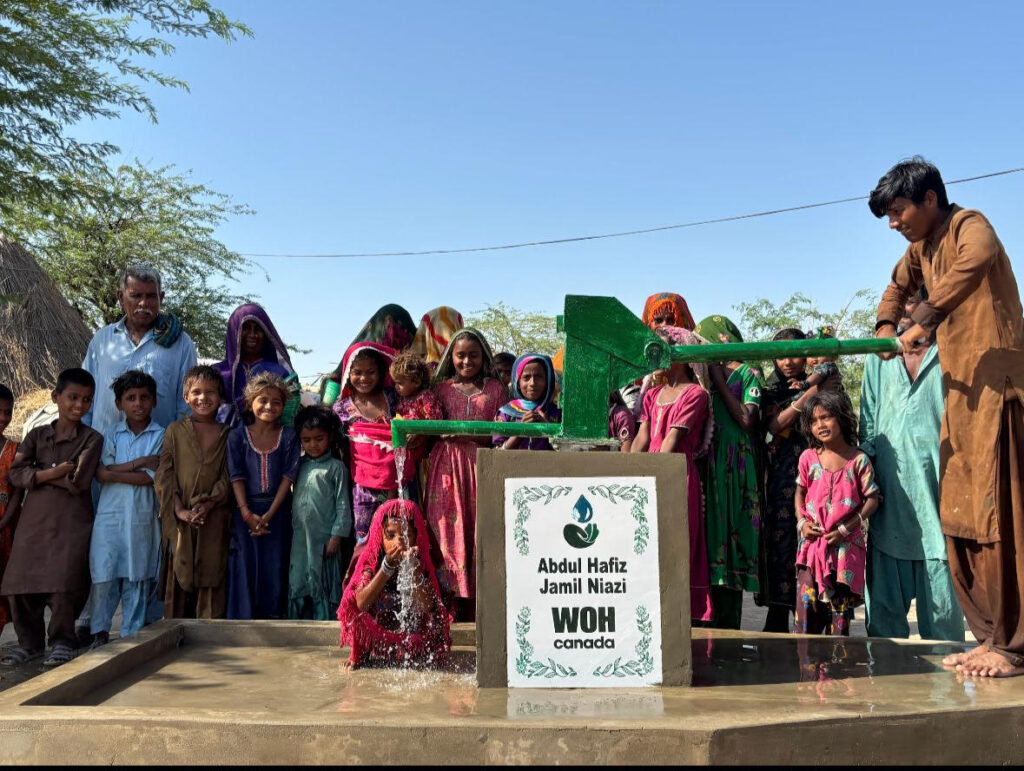
The crisis is more than a statistic; it is a human story. It is the story of Fatima and her children, of families in Karachi waiting for tanker water, and of children in rural Sindh missing school due to preventable illnesses. It is a story of a nation where water flows from mighty rivers yet fails to reach those who need it most. Iqra Afridi, representative of WELL OF HOPES (WOH) Canada and a proud McMaster University alumna, recently highlighted one of the organization’s most significant achievements: the installation of over 100 water wells across Pakistan, bringing safe and sustainable drinking water to countless communities in dire need.
Afridi emphasized that access to clean water is not just a basic necessity but a gateway to improved health, education, and economic opportunities. “Each well represents more than water it represents hope, empowerment, and the promise of a brighter future for families who previously had to walk miles for a single source of drinking water,” she shared.
Afridi also reflected on the personal inspiration behind her work. “Seeing the transformation in communities smiles on children’s faces, mothers no longer worrying about daily access to clean water is what drives us forward,” she said. She hopes that WOH’s model can serve as for other organizations and governments seeking to address water scarcity in underserved regions. With a strong commitment to social impact and grassroots engagement, WOH continues to expand its reach, aiming to bring safe drinking water to even more communities across Pakistan in the coming years. Pakistan stands at a crossroads. Every day of inaction deepens the crisis, putting millions of lives at risk. Safe drinking water is not a privilege it is a fundamental human right. Ensuring its availability is not just a policy matter; it is a moral imperative.